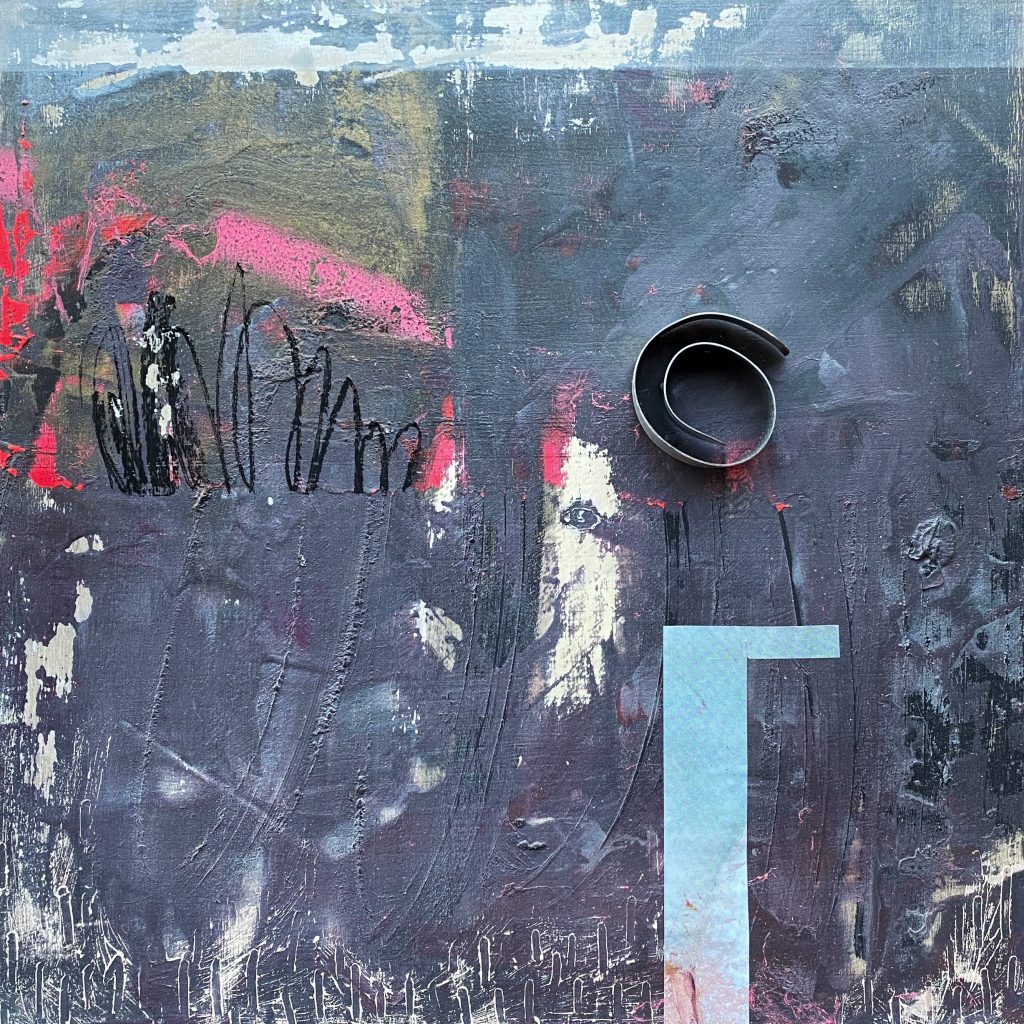
What abstract art means (to me at least)
There’s often a moment, when someone stands in front of an abstract painting and looks slightly uncomfortable. Not necessarily because they dislike it, but because they’re not sure what they’re supposed to do with it.
Abstract art doesn’t give you a clear place to stand. There can be no obvious subject, no fixed meaning, nothing to confirm whether you’re “getting it”, and that uncertainty can feel like a barrier – but that’s kind of the point.
I don’t usually make paintings to illustrate an idea and I’m certainly not trying to translate something neatly from my head onto canvas. If anything, I’m trying to stay just slightly out-of-control in the process; working in that space where something can emerge that I didn’t fully intend. That might sound a bit vague, but it’s actually a real physical thing.
I’ll build up layers, then disrupt them; I’ll make some marks, then bury them; I’ll add collage elements only for them to be partially buried again. There’s a constant negotiation between holding on and letting go; a perpetual push and pull.
Themes that run through my work explore belief, doubt, inheritance, memory and curiosity. These are things that can’t easily be resolved, so the works don’t attempt to answer those questions, but instead hold them.
So when someone asks what a painting “means”, I don’t feel the need to necessarily pin it down too tightly. The meaning isn’t fixed, but instead it shifts depending on who’s looking and when.
What I would say is, abstract art isn’t always something one decodes, it’s something one spends time with and fosters a very individual response to.
If it stays with you, unsettles you slightly, or draws you back in for more, that’s probably enough.